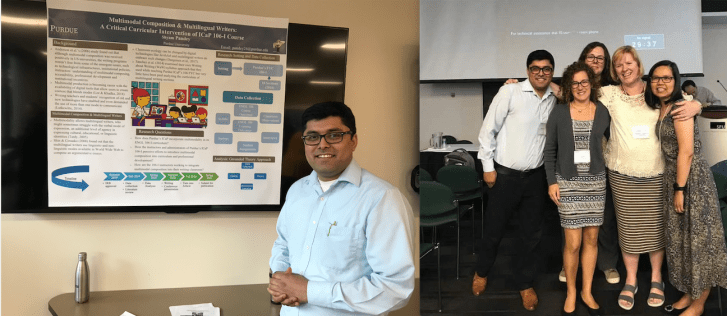
Association of Teachers of Technical Writing (ATTW) 2023
Presentation Title: Promoting Social Justice Through Multimodality: A Case of Study of Transnational Writers
Social justice in technical communication entails ensuring that the information is accessible, understandable, and culturally appropriate for all users, including those from diverse backgrounds (Agboka, 2012; Walton & Agboka, 2021). It also involves addressing systemic inequalities and biases in communication practices and technologies that may perpetuate marginalization or exclusion. Based on the conversation within technical and professional communication (TPC), this paper investigates transnational technical writers’ multimodal communication practices and argues how engaging in multimodal practices helps promote social justice in TPC classrooms.
Conference on College Composition and Communication (CCCC) 2022
Presentation Title: STEM Job Market and Transnational Digital Writers’ Making of Multimodal Career Portfolio
As the STEM job market is changing dramatically, we move from physical-based to mobile and flexible workspaces that are transnational. Companies are becoming increasingly entrepreneurial, so candidates’ career materials are becoming essential. This session highlights transnational digital writers’ engagement in the making of multimodal career portfolio and their approach to find STEM career positions.
Special Interest Group on Design of Communication (SIGDOC) 2021
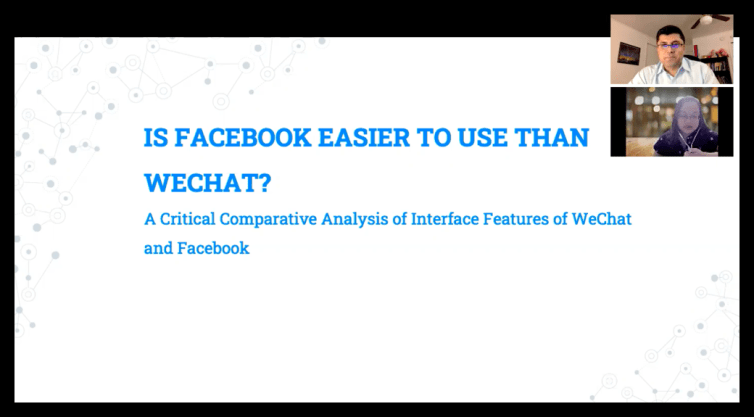
Presentation Title: Is Facebook Easier to Use than WeChat? A Critical Comparative Analysis of Infrastructure Features of WeChat and Facebook
Given the dominant role that Facebook and WeChat play in their respective contexts, researchers have explored users’ behavior and uses of these two globally leading social networking sites (SNSs). However, there is scant research comparing the interface features of these two SNSs and their contextual interactions within and across cultures. Utilizing Sun’s “culturally localized user experience” (CLUE) framework (Sun, 2020; 2012), this study employs critical data analysis to investigate the defining interface features of Facebook and WeChat in four sections of moments/status, official accounts, digital currency, and group chat. Our study expands the understanding of cultural considerations in interface design and encourages factoring contextualized use of technology and the sociological approach to interface design. The findings reveal cultural and local differences are the driving force for the unique interface features of the two SNSs and highlight “glocalization” (mixing forces into local elements) in SNS design (Sun, 2020).
Association of Teachers of Technical Writing (ATTW) 2020
Presentation Title: Moving Beyond Slacktivism: Digital Activist Rhetoric and Data Visualization in Technical Communication
Abstract: Through exploring the tweets featured in the hashtag on Twitter and by using the framework of technofeminism, this study explores how the #MeToo movement functioned as an online social movement to encourage conversation and promote change. More specifically, my paper demonstrates how students can utilize the big data of this social media movement to hone their data visualization techniques. The #MeToo movement has gained and sustained momentum, and although it started in North America, its reach has spread around the globe. These anti-discriminatory tweets showcase that knowing how, when, and why to use social and digital tools is becoming increasingly important even in TC classes, especially as we engage with more digital technologies as we teach. Using teaching artifacts and reflective memos, I demonstrate that successfully linking digital activist rhetoric and data visualization activities can fulfill two purposes: 1) creating a safer workplace and 2) visualizing big data. As a technofeminist framework affords researchers an avenue for examining issues of inequity, power, and access and can help to redress imbalances of power that privilege some voices over others in social media spaces (Gallagher, & Garza, 2012), this paper attempts to contribute to a disciplinary conversation about digital activism and data visualization in TC lessons. I conclude by recommending that pedagogies that invite students to trace, analyze, and visualize the rhetorical delivery of an activist movement on a social media platform can help move us beyond the activism-slacktivism binary.
Conference on College Composition and Communication (CCCC) 2020
Presentation Title: International Perspectives on Inclusion and Open Access
Abstract: While writing programs in the US face tremendous pressure to internationalize and address the issue of diversity, populations remain who have been excluded from the current corporate system (Ayash, 2015). Many have been struggling to have access to the resources that are easily available in the US or a few other parts of the world (Canagarajah, 2006; Matsuda, 2010). Consequently, the notion of internationalization is challenged by the current corporate system. In terms of accessibility, knowledge-making, and research practices, only developed nations have been able to access the most sponsored zone of resources while still leaving the rest of the world mostly excluded from access because of the current system which is guided by the corporate model. Speaker five argues why and how OA is crucial to embrace the notion of globalization, cultural inclusivity, and diversity in our research practices, and how an ethical internationalization would effectively utilize open access to move more people to have greater access to information resources.
Computers and Writing 2020
Presentation Title: Multimodality, Inclusivity, and Multilingual Writers
Abstract: Adopting multimodal composition does not only make writing pedagogies socially justifiable, but it also makes writing pedagogies more inclusive. While multilingual writers have diverse writing experiences, their best mode of composing may not be the alphabetic one. Since studies have shown that multilingual writers can equally benefit from using multiple modes in their composing, asking them to work in a single mode inhibits their composing process. Inspired by the universal design model and social-semiotic approach, this presentation highlights the preliminary findings of a study that examines the FYC curriculum of a large Midwestern university.
 Shyam B. Pandey, Ph.D.